
The world's largest technology companies are on course to spend more than $725 billion on artificial intelligence in 2026, but the hardest constraint on their ambitions is no longer a shortage of chips or engineers. It is electricity.
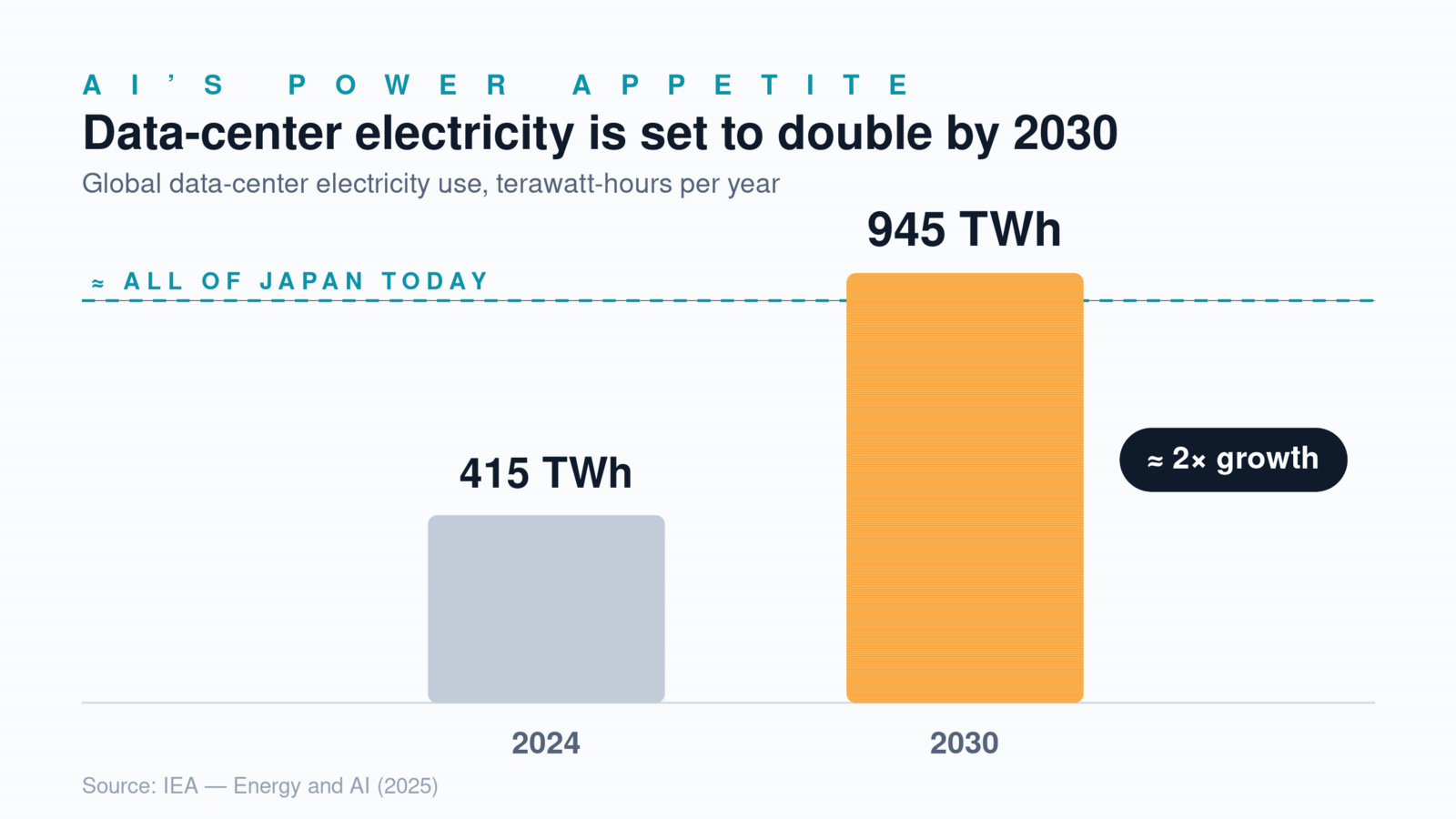
Artificial intelligence runs in data centers — warehouse-scale buildings packed with power-hungry processors — and their appetite is beginning to reshape the world's power systems. Global data-center electricity use is on track to roughly double by 2030, to about 945 terawatt-hours, more than Japan consumes in a year, according to the International Energy Agency. In the United States, the agency projects data centers will soon draw more power than domestic production of steel, cement and aluminum combined.
That demand is colliding with a grid that cannot keep pace. More than 2,060 gigawatts of power projects were waiting to connect to the US grid at the end of 2025, according to Lawrence Berkeley National Laboratory, with interconnection waits stretching for years in some regions. The bottleneck has turned the physical plumbing of electricity — turbines, transmission lines, transformers and cooling systems — into some of the most sought-after products in the economy, lifting the fortunes of companies well outside the AI spotlight.
Generating the power: GE Vernova
The first constraint is generation. GE Vernova (NYSE: GEV), the power-equipment business spun out of General Electric, expects its gas-turbine backlog to reach about 80 gigawatts, with orders booked into 2029 and beyond, according to Utility Dive. With turbine slots effectively sold out for years, operators that want new capacity must either wait or pay a premium for an existing order — making the manufacturer of the machines that make electricity a chokepoint for the entire build-out.
Moving the power: Quanta Services
Generating electricity is only useful if it can reach the data centers, which often means hundreds of miles of high-voltage line that does not yet exist. Quanta Services (NYSE: PWR), the largest US contractor for building and upgrading transmission infrastructure, reported a record backlog of $48.5 billion in the first quarter of 2026. Every new data center adds to the queue of grid work the company is contracted to build.
Inside the building: Eaton
Within a facility, electricity must be stepped down, switched and protected before it reaches a processor — a chain of transformers, switchgear and power-distribution equipment supplied by companies such as Eaton. In March 2026, Eaton agreed to pay $9.5 billion for Boyd's thermal-management business, a bet on controlling more of the path it describes as "grid to chip." As a single AI rack can draw as much power as a small neighborhood, that once-mundane equipment has become a growth market. Eaton trades as NYSE: ETN.
The chip's other half: SK Hynix
Attention on AI silicon centers on graphics processors, but keeping them fed with data depends on a specialized component called high-bandwidth memory, or HBM — stacks of memory chips placed alongside the processor. South Korea's SK Hynix (KRX: 000660), the market leader in HBM, reached a $1 trillion valuation in May 2026, a threshold few companies ever cross, CNBC reported. In the current build-out, the scarcest resource inside the machine is often memory bandwidth rather than raw computing power.
Carrying away the heat: Vertiv
Every watt a chip consumes leaves as heat, and the densest AI systems now exceed what air conditioning can remove, forcing operators to pipe liquid coolant directly onto the silicon. Vertiv (NYSE: VRT), which builds data-center power and cooling systems, has risen more than 80% in 2026 and briefly doubled at its May peak, according to MacroTrends — a sign of how much investor attention has shifted from the chips themselves to the systems that keep them running.
The bubble question
The build-out rests on a wager that may not pay off. AI spending far exceeds AI revenue, and some financing has become circular, with chipmakers investing in the AI companies that buy their chips — a pattern that has intensified warnings of a bubble, NPR reported. The Bank for International Settlements has flagged a shift from cash-flow to debt financing of the expansion. Were the boom to slow, the infrastructure suppliers could see orders trimmed first. But turbines already ordered and transmission lines under construction will not be un-built, and much of the grid needed replacing regardless — leaving the physical investment more durable than the AI trade that triggered it.
What it means for households
The costs are already reaching consumers. In PJM Interconnection, the largest US grid region, the "capacity" price utilities pay to guarantee supply rose roughly tenfold in two years, from $28.92 to $329.17 per megawatt-day, an increase the Institute for Energy Economics and Financial Analysis attributed largely to data-center growth. In Washington, DC, households saw bills climb about $21 a month, roughly half of it traced to that increase, according to E&E News.

For all the attention on chatbots and chips, the AI era is turning into one of the largest expansions of physical infrastructure in a generation — a build-out of power plants, wires, switchgear and cooling systems whose beneficiaries remain largely invisible to the public. Whether the boom proves durable or not, the grid is being rebuilt around it.