On January 29, 2026, the Federal Communications Commission handed the Wi-Fi industry a decisive victory. It opened the 6 GHz band to a new class of higher-power, outdoor-capable devices — a category it calls "geofenced variable power," or GVP. The order deepens a distinctly American bet: that the most sought-after stretch of wireless spectrum should be free for anyone to use, rather than auctioned to the highest-bidding carrier.
The stakes are larger than a faster home router. The 6 GHz band sits in the "mid-band" range that the industry calls beachfront property — the sweet spot that balances coverage and capacity, and the exact real estate 5G carriers most want. When a comparable slice of mid-band went to auction in 2021, the major carriers paid more than $81 billion for the exclusive right to use it. The United States has instead given 6 GHz to unlicensed Wi-Fi — and just voted to let it do more.
The band everyone wants
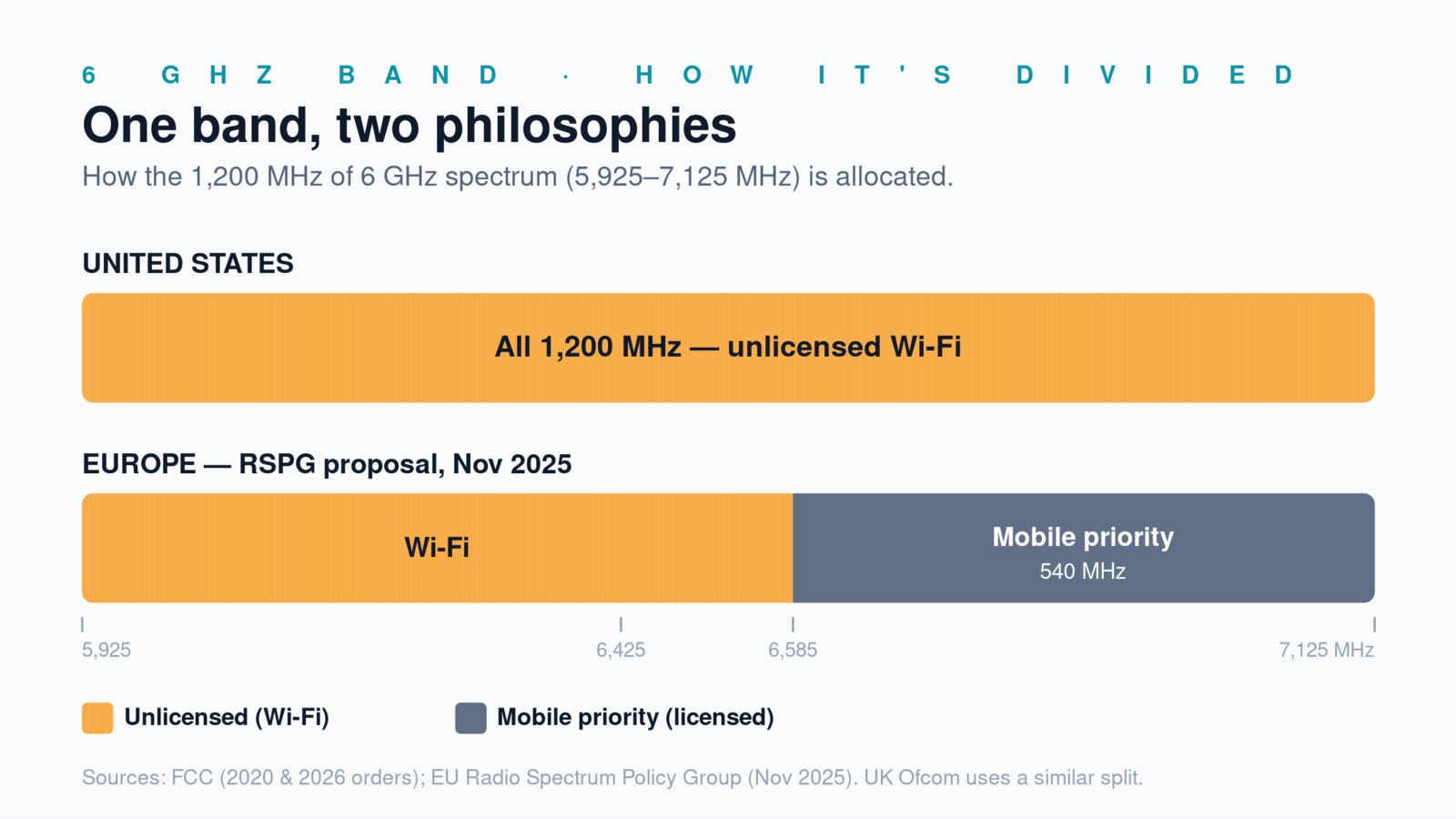
The story begins in April 2020, when the FCC under then-Chairman Ajit Pai voted to open the entire 1,200 MHz of the 6 GHz band, from 5.925 to 7.125 GHz, to unlicensed use — increasing the spectrum available for Wi-Fi in the US roughly fivefold, in the agency's own estimation. That single decision created the room for Wi-Fi 6E and Wi-Fi 7, the first generations able to use wide, uncongested channels in a band few other services occupied.
The word doing the work is unlicensed. Cellular spectrum is licensed: a carrier buys the exclusive right to a band at a government auction and no one else may transmit there. Unlicensed spectrum, like the bands Wi-Fi and Bluetooth already share, belongs to no one — any device that meets the technical rules can use it, for free. The 6 GHz question is whether the single largest chunk of prime mid-band opened in a generation belongs in the first camp or the second.
What the FCC just added
The January order does not hand over new spectrum; it changes what devices are allowed to do inside the band. Until now, 6 GHz Wi-Fi came in two constrained forms — low-power access points confined indoors, and very-low-power devices that can go outside but only at a whisper. GVP devices operate at higher power both indoors and out, using geofencing to stay off certain frequencies inside "exclusion zones" that protect incumbent licensed users such as utility and public-safety microwave links.
"This next generation of Wi-Fi will offer blazing fast speeds, massive capacity and better power efficiency — this is a big deal," Chairman Brendan Carr said after the vote, framing the band as "a platform for America's wireless leadership." The agency pitched the devices as enabling augmented- and virtual-reality headsets, AI wearables, outdoor hotspots, factory automation and indoor navigation. The measure, adopted as a Fourth Report and Order, drew support from Carr and Democratic Commissioner Anna Gomez alike, and praise from the Computer & Communications Industry Association, whose members include Alphabet (NASDAQ: GOOGL), Amazon (NASDAQ: AMZN) and Microsoft (NASDAQ: MSFT).
Why 6 GHz was almost clawed back
That Wi-Fi kept the band was not a foregone conclusion. In July 2025, the One Big Beautiful Bill Act restored the FCC's lapsed authority to auction spectrum and ordered regulators to identify at least 800 MHz to sell from a wide range between 1.3 and 10.5 GHz. An earlier draft of the bill explicitly shielded the 6 GHz unlicensed band; the final version did not, leaving it, at least on paper, eligible for the auction block.
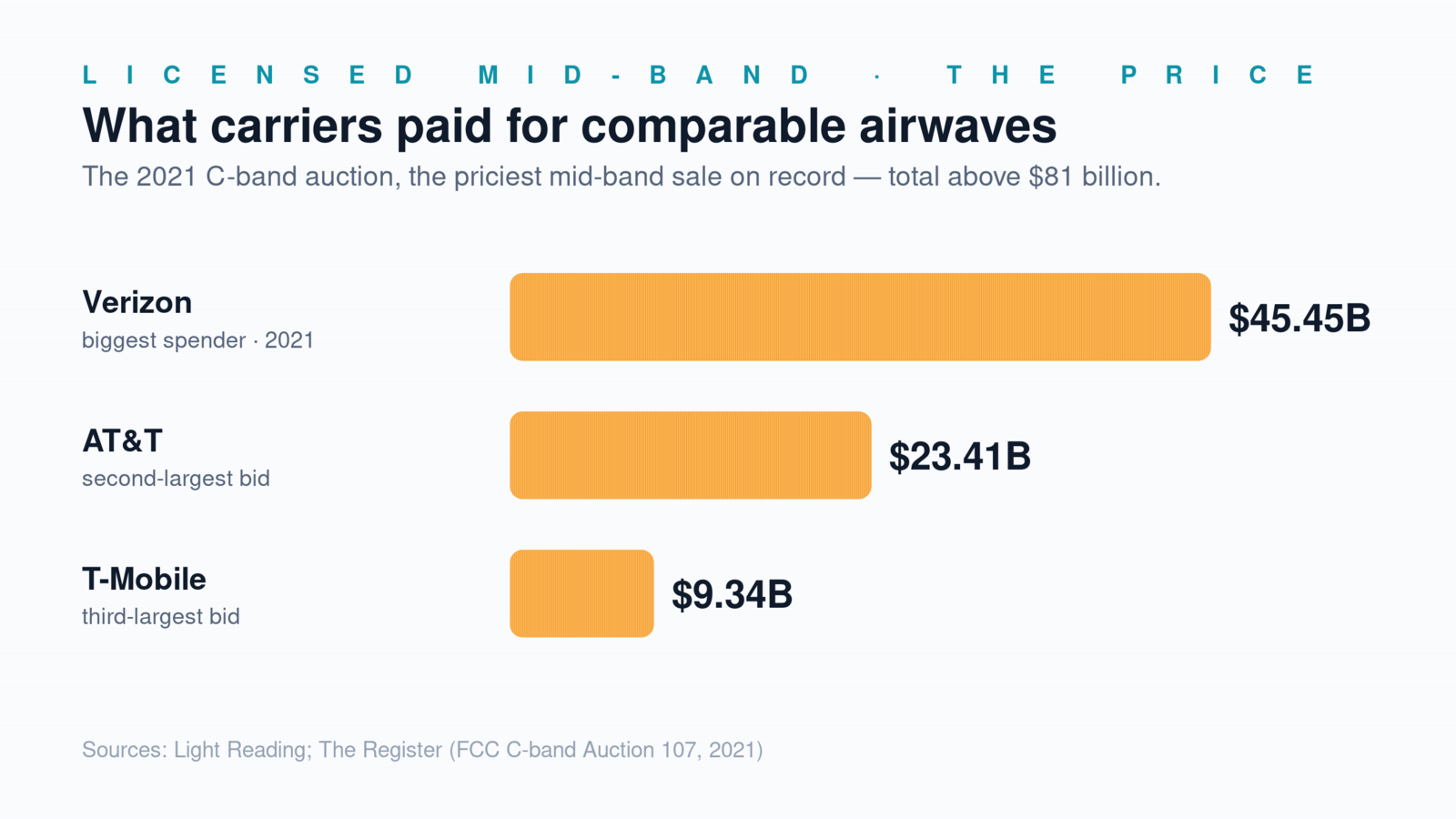
Carriers have long argued that mid-band this good should be licensed for 5G, and the economics explain the appetite. In the 2021 C-band auction — the priciest mid-band sale in history — Verizon (NYSE: VZ) alone paid $45.45 billion, with AT&T (NYSE: T) spending $23.41 billion and T-Mobile (NASDAQ: TMUS) $9.34 billion. Exclusive mid-band spectrum is worth a fortune, which is precisely why control of 6 GHz has been contested rather than settled.
The case for leaving it free
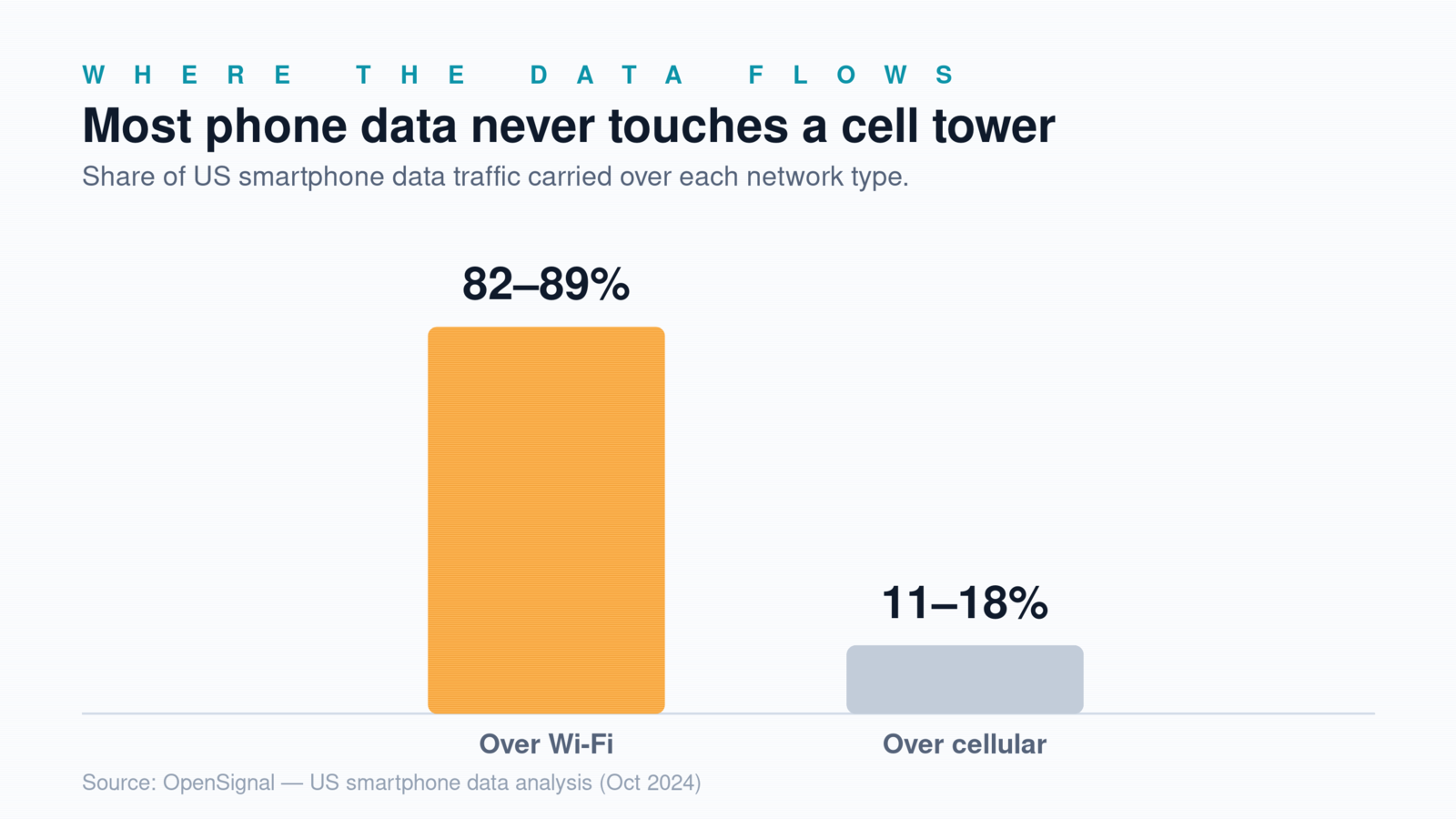
Against that pull is the way Americans actually use their phones. Most smartphone data never touches a cellular tower: an OpenSignal analysis in late 2024 found Wi-Fi carries between 82 and 89 percent of US smartphone data traffic, depending on the carrier. The network most people rely on most of the day is the unlicensed one.
Wi-Fi's advocates argue the band is worth more left open than sold off. A study by Dr. Raul Katz's Telecom Advisory Services, commissioned by the industry group WifiForward, projects the annual US economic value of Wi-Fi will reach $2.4 trillion in 2027, with the 6 GHz band contributing more than $1 trillion of it. A follow-on analysis estimated that reserving just the upper 700 MHz of the band for licensed use would cut the band's value from $1.19 trillion to $468 billion. Those numbers come from Wi-Fi's own backers and should be read that way, but the underlying point is not seriously disputed: unlicensed spectrum has become a vast, largely invisible engine of the consumer internet.
The world went the other way
What makes the American choice striking is that much of the world is doing the opposite. In Europe, mobile operators have pushed to claim the upper 6 GHz for 5G and future 6G networks. In November 2025, the EU's Radio Spectrum Policy Group recommended giving mobile networks priority access to 540 MHz of the upper band, from 6,585 to 7,125 MHz, and a coalition of a dozen European carriers including Vodafone (NASDAQ: VOD) and Deutsche Telekom has lobbied for the entire upper band. The UK's Ofcom split the difference, giving Wi-Fi priority at the bottom of the upper band and mobile at the top. As one spectrum-policy consultant observed, "while Europe is looking to reserve the upper 6 GHz band for mobile, the US is doubling down on unlicensed access."
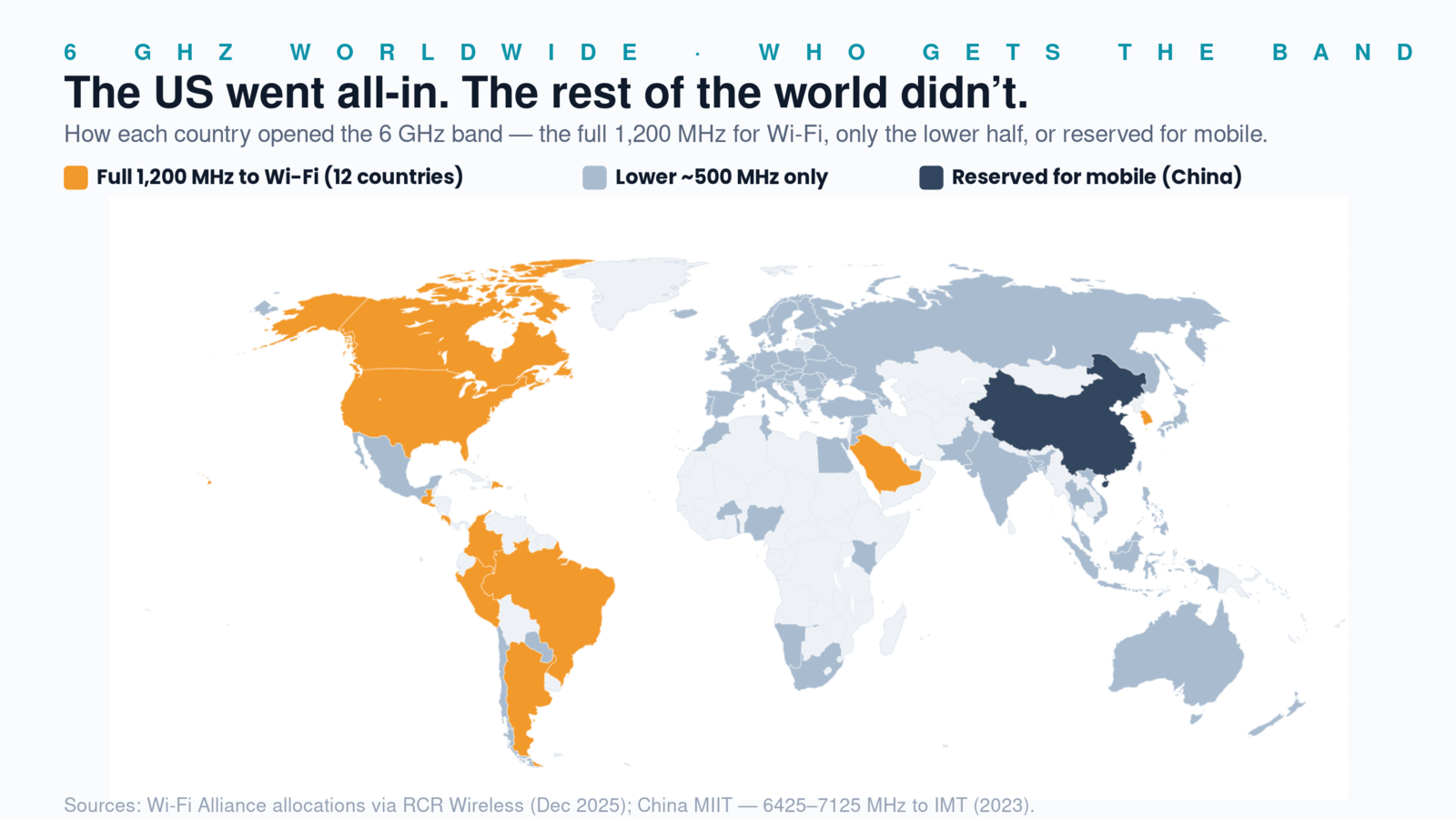
Zoom out, and the United States looks like an outlier. Only about a dozen countries — among them Canada, South Korea, Saudi Arabia and much of Latin America — have opened the full 1,200 MHz for unlicensed Wi-Fi, according to Wi-Fi Alliance data; most of the world has cleared only the lower half. China went furthest in the other direction, reserving the 6,425 to 7,125 MHz range for mobile 5G and 6G in 2023.
What it means
The January order is not just a shield; it is an expansion. By letting 6 GHz Wi-Fi run at higher power and outdoors, the FCC made the band materially more useful — and, in doing so, made a future clawback for auction harder to justify. The hardware is not on shelves yet: manufacturers still have to build the geofencing systems and certify devices, and the agency is taking comment on further changes, including higher-power access points and Wi-Fi on cruise ships. Carriers, meanwhile, will keep pressing for mid-band as 6G research advances.
But the direction is now set. The fight over 6 GHz was never really about a band of frequencies. It was a choice between two models of wireless — one you pay a carrier to reach, and one built into the router in your closet — and for the largest chunk of prime spectrum in a generation, the United States has placed its bet on the second.