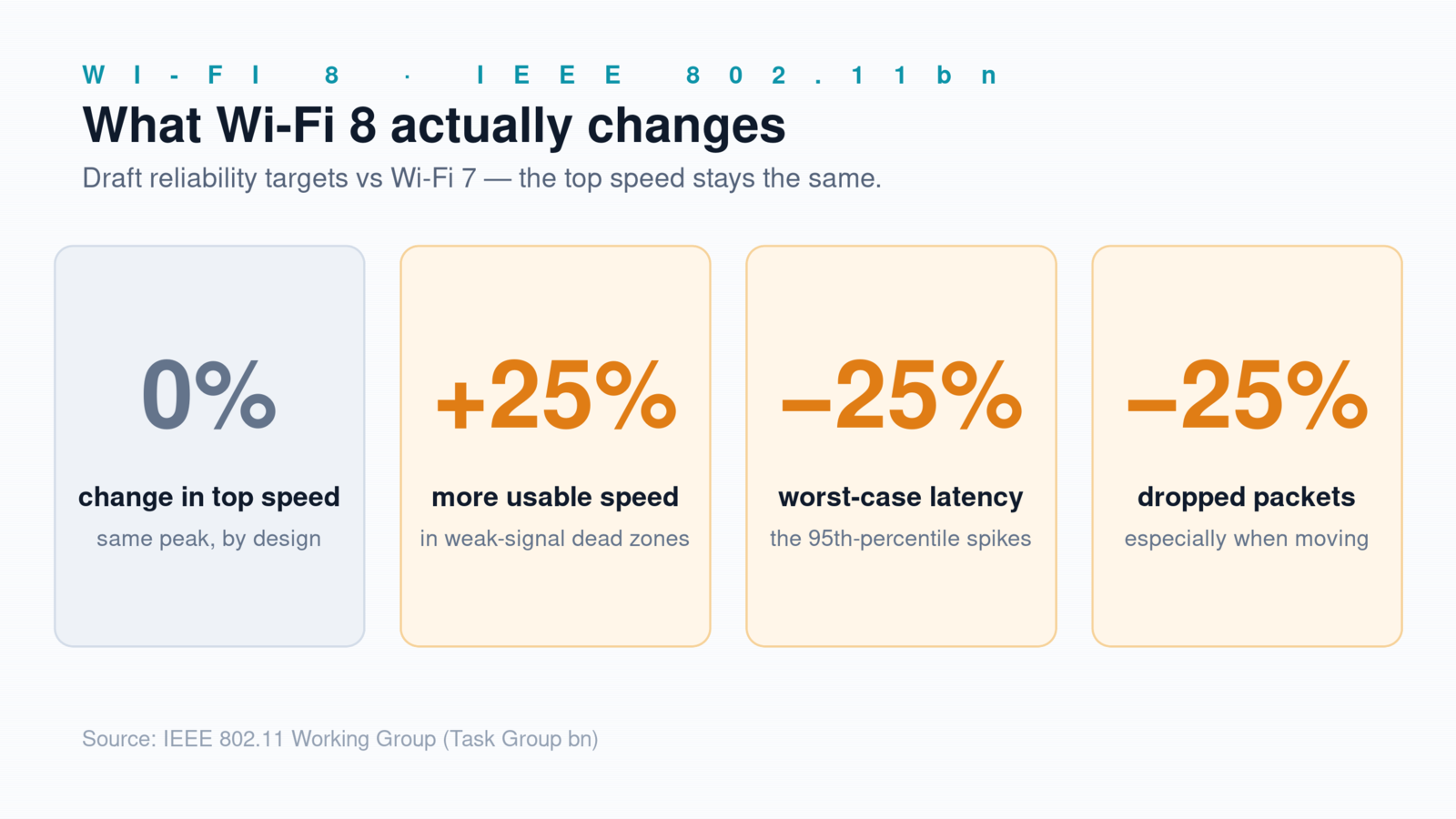
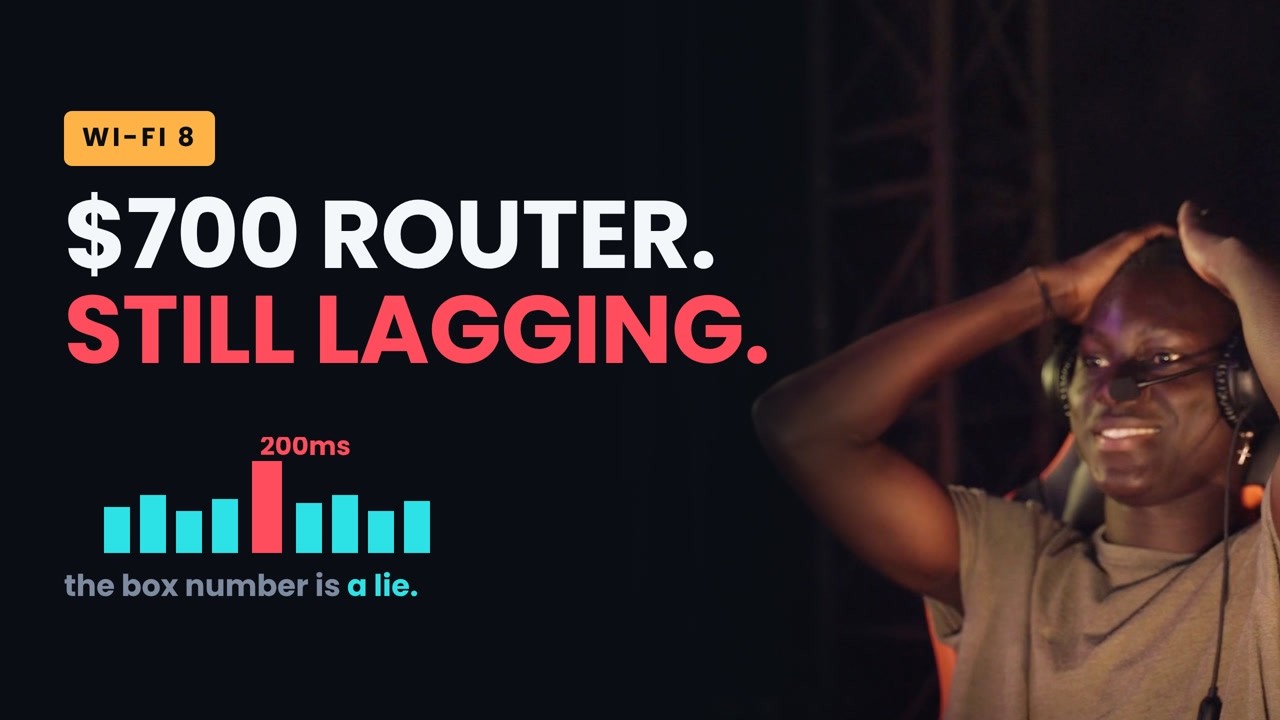
A high-end gaming router on sale today advertises a headline figure of 30,000 megabits per second and the tagline "game beyond speeds." The next generation of Wi-Fi will not add a single one of them. Wi-Fi 8, the standard now being finalized as IEEE 802.11bn, is designed to deliver the same peak throughput as Wi-Fi 7 — on purpose.
After two decades in which each Wi-Fi generation was sold on a bigger top-line number, the engineers writing the standard have made reliability, rather than speed, the explicit goal. Industry coverage has summarized it as prioritizing reliability over speed gains, and the standard's formal name reflects the shift: Ultra High Reliability. The premise is that the number on the box was never what degraded most connections in the first place.
The number on the box
That 30,000-megabit figure — marketed as "BE30000" on the ASUS (TPE: 2357) ROG Rapture GT-BE98 Pro, which retails for about $700 — is the combined theoretical maximum of the router's four radios under laboratory conditions. A single device connects to one radio and negotiates a fraction of it. Independent testing puts real-world Wi-Fi 7 throughput at roughly 6–15 Gbps per access point, against a theoretical peak near 46 Gbps that no consumer hardware approaches.
So when the standard was defined, the target changed. The 802.11bn charter sets three measurable goals, each roughly 25 percent and each measured against Wi-Fi 7: more usable throughput at a given (weak) signal level, lower latency at the 95th percentile, and fewer lost data packets, particularly as a device moves between access points. None of them raises the peak rate. Those targets map onto four reliability problems that degrade real-world connections.
The range problem
The advertised speed is measured next to the router; most devices are not. As a signal weakens with distance and walls, the radio downshifts to a slower, more robust way of encoding data. Wi-Fi 8's first target addresses that edge: roughly a quarter more usable throughput at the same weak signal, while the close-range peak stays the same. An early proposal to let nearby devices relay a weak signal did not survive into the current draft; what remained is a more robust long-range mode, plus the access-point coordination described below.
The latency problem
Average latency is a poor measure of a live connection: a single packet arriving 200 milliseconds late can disrupt a video call, a game or an industrial control loop. Rather than the average, the standard targets the tail — the 95th-percentile worst cases — aiming to cut them by about a quarter. The requirement originated not with consumer use but with industrial applications, where a late packet can halt a production line.
The roaming problem
In a mesh network — the multi-node systems sold under brands such as eero, Orbi and Deco — a device crossing between nodes today disconnects, re-authenticates and reconnects, a gap of up to about half a second. Wi-Fi 8 is designed to make that handoff seamless: the receiving access point holds the device's credentials and session before it arrives, so the connection is never torn down, and the previous node can forward packets that would otherwise be lost. The targeted reduction in dropped packets is aimed squarely at this case.
The congestion problem
The largest structural change is not inside any single router but between routers. Wi-Fi's long-standing rule is that on a given channel, one radio transmits while the others wait — which is why performance collapses in dense apartment buildings at peak hours. A new framework called Multi-AP Coordination lets neighboring access points cooperate: taking turns, steering their signals away from one another, and in some cases transmitting at the same moment at lower power. Multi-AP Coordination was studied during Wi-Fi 7 and postponed for complexity, which makes it one of the genuinely new capabilities in Wi-Fi 8 rather than a carry-over.
The mechanisms behind it
The reliability targets are delivered by a set of named mechanisms in the current draft (IEEE 802.11bn D1.5), each aimed at a different failure mode:
- Seamless roaming — the Seamless Mobility Domain (SMD). Lets a device move between separate, non-colocated access points without re-associating. It stays authenticated across the group and keeps its session context, so connectivity drops for a fraction of the usual time and little or no data is lost in the handoff.
- Non-Primary Channel Access (NPCA). When a neighboring network is occupying a device's main 20 MHz channel, NPCA lets the device temporarily switch to an alternate channel and keep transmitting instead of waiting its turn — cutting the stalls that come from crowded airwaves.
- Prioritized EDCA (P-EDCA). A tuned version of Wi-Fi's contention rules that shortens the worst-case wait for time-sensitive traffic such as voice, trimming the latency tail rather than the average.
- Dynamic Subband Operation (DSO). Lets an access point hand a narrower-bandwidth device spare frequency elsewhere within the network's channel, on a per-transmission basis, so idle spectrum gets used instead of sitting empty.
- Dynamic and Periodic Unavailability Operation (DUO and PUO). Let a device — or the access point itself — formally announce windows when it will be unavailable, for example to save power or attend another link, so the network schedules around it rather than wasting airtime on a station that cannot answer.
None of these raises the standard's peak data rate. Every one targets latency, coexistence, mobility or efficiency — using the available spectrum more intelligently rather than lifting the ceiling. That is the through-line of the whole standard: Wi-Fi 8 is engineered to make the connection more dependable, not faster.
When it arrives
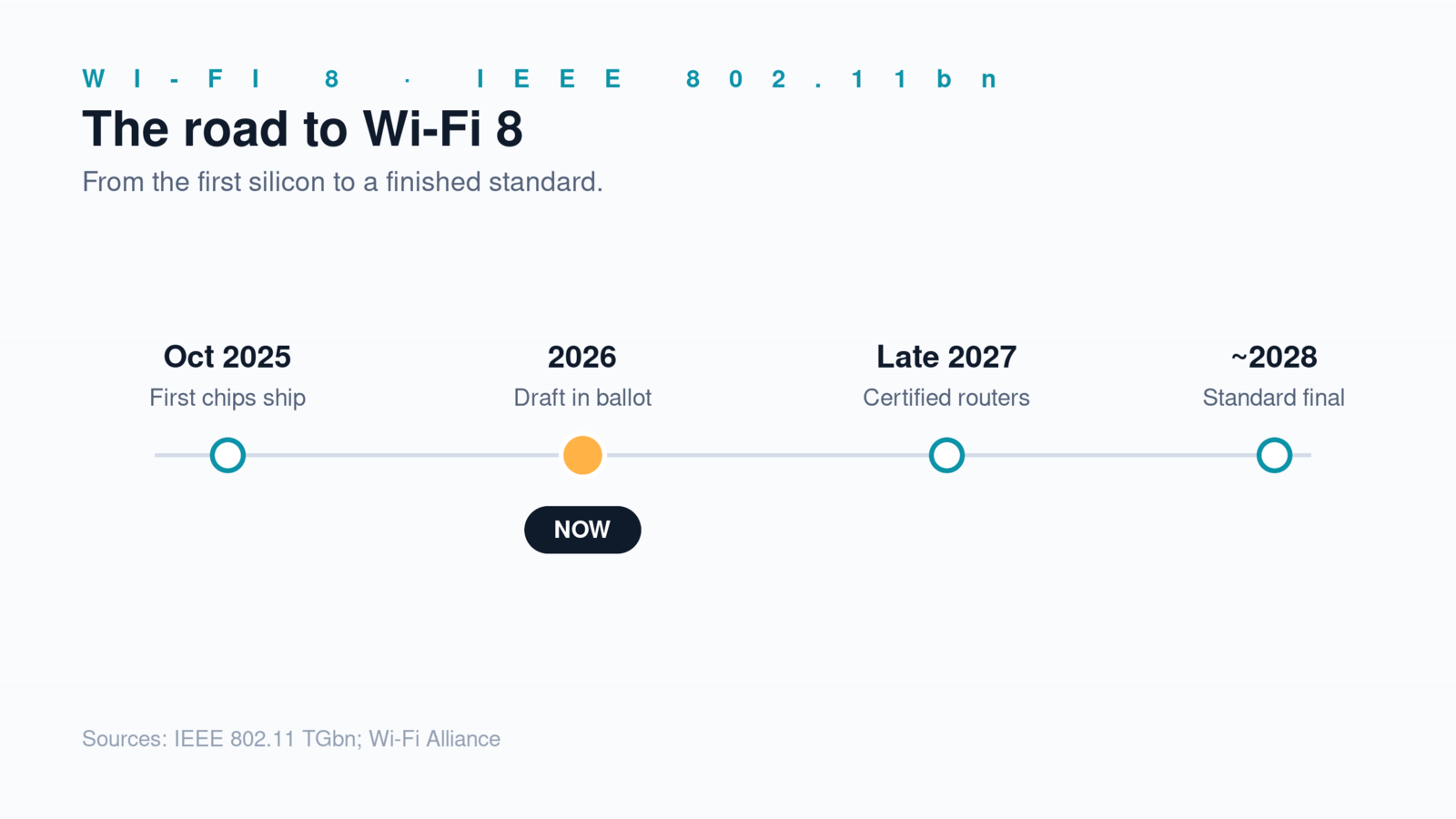
Wi-Fi 8 cannot be bought yet. The draft is in ballot as of 2026, and the Wi-Fi Alliance is expected to certify products around late 2027, with the standard finalizing near 2028. Silicon is nonetheless already shipping ahead of the specification: Broadcom (NASDAQ: AVGO) announced the first Wi-Fi 8 chips in October 2025 and showed a full home platform at CES in January 2026, built against a draft that can still change.
The caveats
Not everything is new. Multi-link operation and improved roaming began in Wi-Fi 7; Wi-Fi 8 refines rather than replaces them. It uses the same 2.4, 5 and 6 GHz bands as its predecessor, with no new spectrum. And for a device that can be wired, an Ethernet connection still outperforms any of it.
For now, the practical implications are modest. A speed test run where a device is actually used, rather than beside the router, reveals the coverage gap Wi-Fi 8 is designed to close. And because Wi-Fi shares airtime, the slowest device on a network can drag down the rest — a problem of airtime rather than bandwidth that moving a legacy device to a guest network can address today. What Wi-Fi 8 will not do is make the top-line number bigger. That is the point.